Martin Luther
-
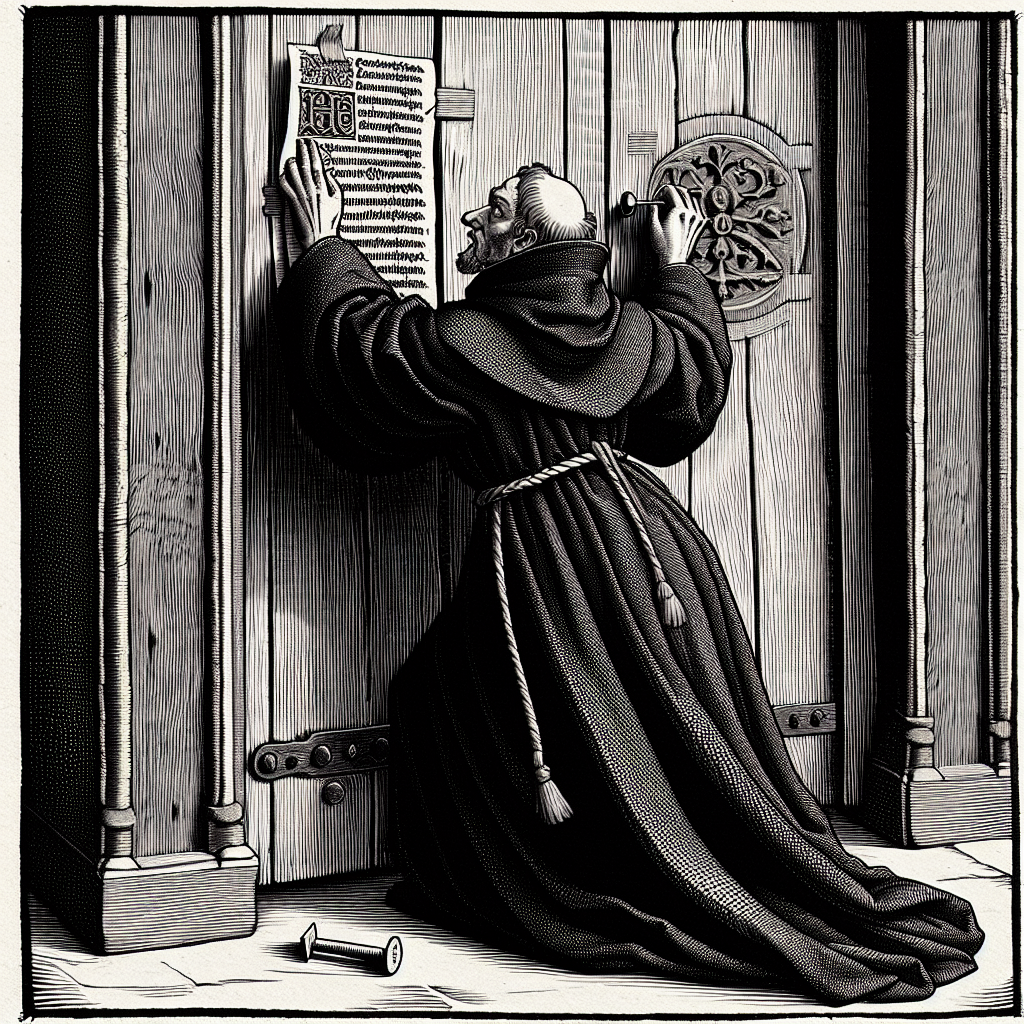
Today in #EuropeanBios is entry #43, Martin Luther, who is famous for nailing criticisms of the Catholic church to a door and starting Lutheranism and protestantism in general. The first he didn't do, and the second he didn't intend to do. The reality is fascinating!
-
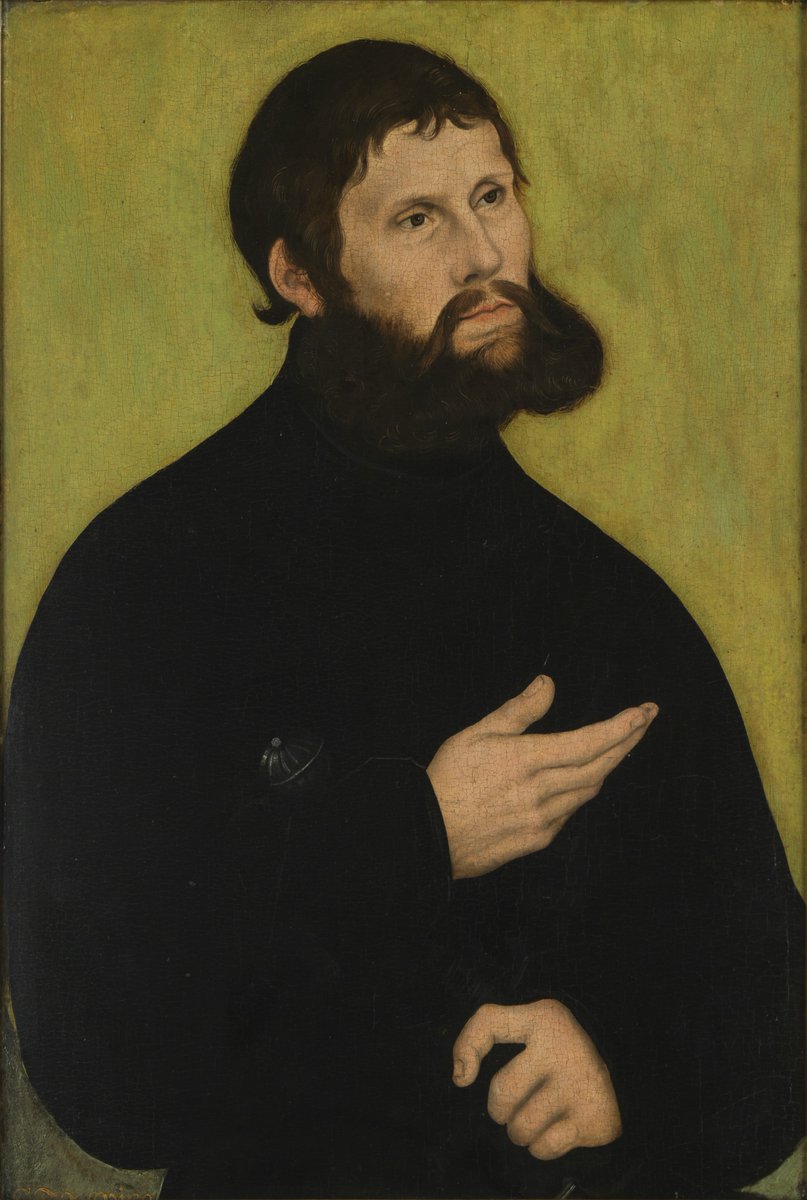
Portrait of Martin Luther, Lucas Cranach the Elder, 1520 public domain -
(If you're new, Project #EuropeanBios is a series of Twitter threads about famous European historical figures, from 500 BC to 1963. I mine for fun facts and comedy, people whose reputations don't match their lives, and queer people. And I love it when their lives intersect.)
-
Luther's story is really not about Luther at all; it's about the printing press. Luther was the world's first superstar author and an amazing demonstration of how an advance in information technology can blow up an established system by disintermediating producers and consumers.
-
But let's start at the beginning. As has been the case with every major religious figure we've covered, Martin was born rich. His father owned copper mines and smelting plants, which allowed him to afford excellent educations for his children including Martin, born in 1483.
-
As is equally traditional with religious figures, Luther's background was retroactively changed to be poor and worthy but this is bullshit. His father had grand plans for his son but Martin blew these up when he decided to become an Augustinian monk.
-
Martin Luther's connections to our other subjects are frequent and this is the first; Augustine of Hippo was one of our previous subjects and in the intervening 2,000 years the Christian church changed a lot; for instance, farting was no longer considered holy.
-
Martin's monks were Scholastics, inspired by Thomas Aquinas, who technically I also covered (TKTKTK). They tried fruitlessly to reconcile religious teachings with that of philosophers like Aristotle and Plato, also previous subjects:
-
Martin, a nerdy and pedantic young man, found this deeply unsatisfying and frustrating. His confessor, Johann von Staupitz, saw intellectual potential in him and encouraged his career, sending him to earn further doctorates and degrees in theology. He became an academic.
-
(Staupitz also once sent Luther to Rome, his only trip outside of Germany in his life, to help resolve a dispute. He was horrified by the corruption of Rome. On the way, he stopped off in Florence and caught Michelangelo's recently-completed work, David: TKTKTK)
-
My first surprise of Luther's bio was learning that monks at the time did not generally spend much time reading the bible. In fact, almost nobody read the bible, not even priests. Religious truth was defined by the church and its teaching, which diverged greatly from the bible.
-
The reason for this is partly because there just weren't a lot of Bibles around. Gutenberg's printing technology had been invented only 40 years earlier. When books were rare and expensive, the church had evolved not to use them. But books were suddenly much cheaper.
-
Simultaneously, the church had veered deeper than usual into corruption. Partly to raise funds for the rebuilding of Rome, the church was selling more and more indulgences, which were a sort out of get-out-of-hell-free card you bought instead of any time-consuming repenting.
-
To raise funds faster, the church dispatched special preachers whose job was to sell as many indulgences as possible. Like all sales people, they got carried away and started over-promising, selling indulgences for sins you hadn't committed yet, for people who had already died.
-
In one famous incident a noble bought an indulgence for a sin he hadn't committed yet, got it, then when the indulgence-seller was leaving town he waylaid him and robbed him and said "that was the sin I paid for". He was not punished.
-
I also like the idea that Michelangelo, whose biography is 80% him griping about not getting paid by the Pope, was thus indirectly responsible for the Pope raising a ton of money via indulgences, thus annoying Luther and sparking the reformation. Good going.
-
Indulgences had no basis in Christianity (as defined by Augustine) or the Bible and Luther knew that. But the Church's position was that they defined what Christianity was, so if the pope said it was true and okay, it was okay by definition. This irritated Luther enormously.
-
Luther decided the truth of Christianity lay in the Bible, and that things were only true if they could be supported by scripture. The church, even the pope could be wrong if what they said wasn't backed by scripture. This was Luther's famous 95 theses.
-
(As an aside: this is kind of a weird take! If you've decided humans are fallible, and can't be relied upon to know the truth of the faith, why would the Bible be different? Humans wrote the Bible, too! How do you know your translation is accurate? Luther never addressed this.)
-
Here Luther's myth departs sharply from reality. In the myth, a rebellious young monk nails a provocative criticism to the very doors of the church, introducing brand new ideas in how to think about god and religion and kicking off centuries of turmoil. None of this is true.
-
Firstly, the ideas weren't new. Substantially the same ideas had been put forth a hundred years earlier by Jan Hus. He'd kicked off major reforms and had been burned at the stake for heresy. The major difference between him and Luther was Hus hadn't written any books.
-
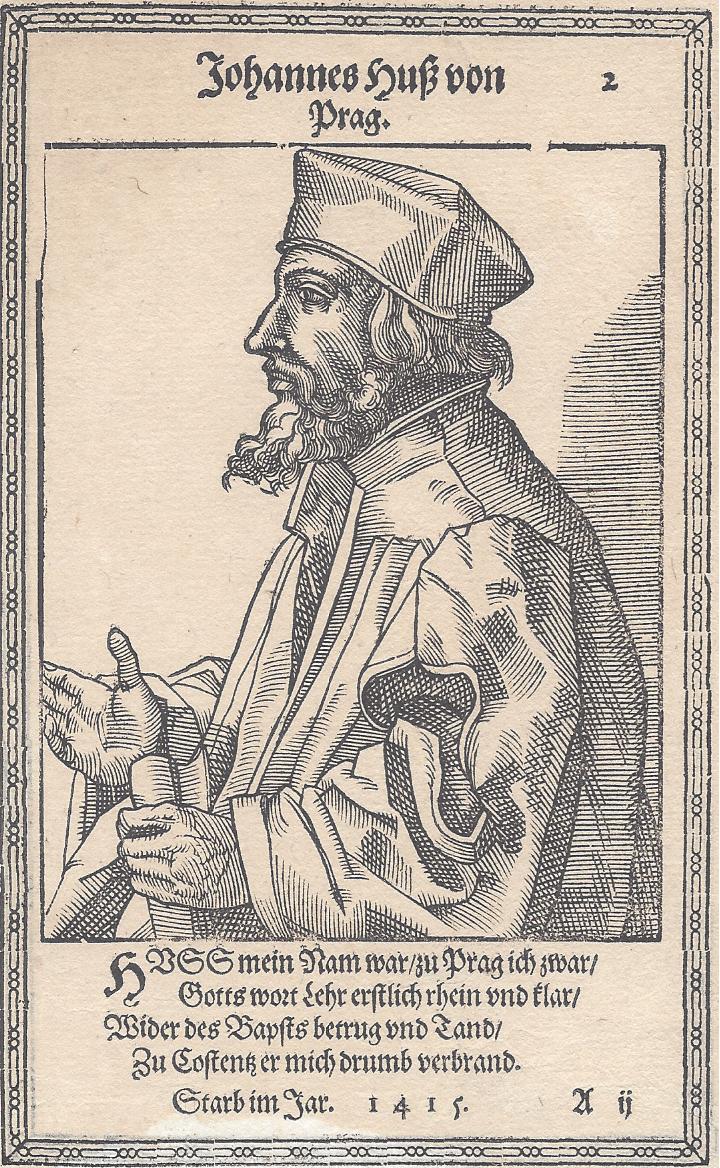
Portrait of Jan Hus of Prague, woodcut, 16th century public domain -
Second, Luther was anything but rebellious. He was almost comically deferential to the church and the Pope in particular. He wasn't trying to rebel against the church; he loved the church, he was a monk! He was trying to steer it back to the truth as gently as he could.
-
Third, he wasn't trying to publish a public criticism for wide consumption. He was an academic, and his 95 Theses were academic arguments. He was trying to get the attention of other academics. It was more like he was announcing an academic conference.
-
Then why the doors of the church? Because that was where everybody posted things. The church was on the main street and got lots of foot traffic; it was where everybody in town posted notices of every kind, like a local bulletin board.
-
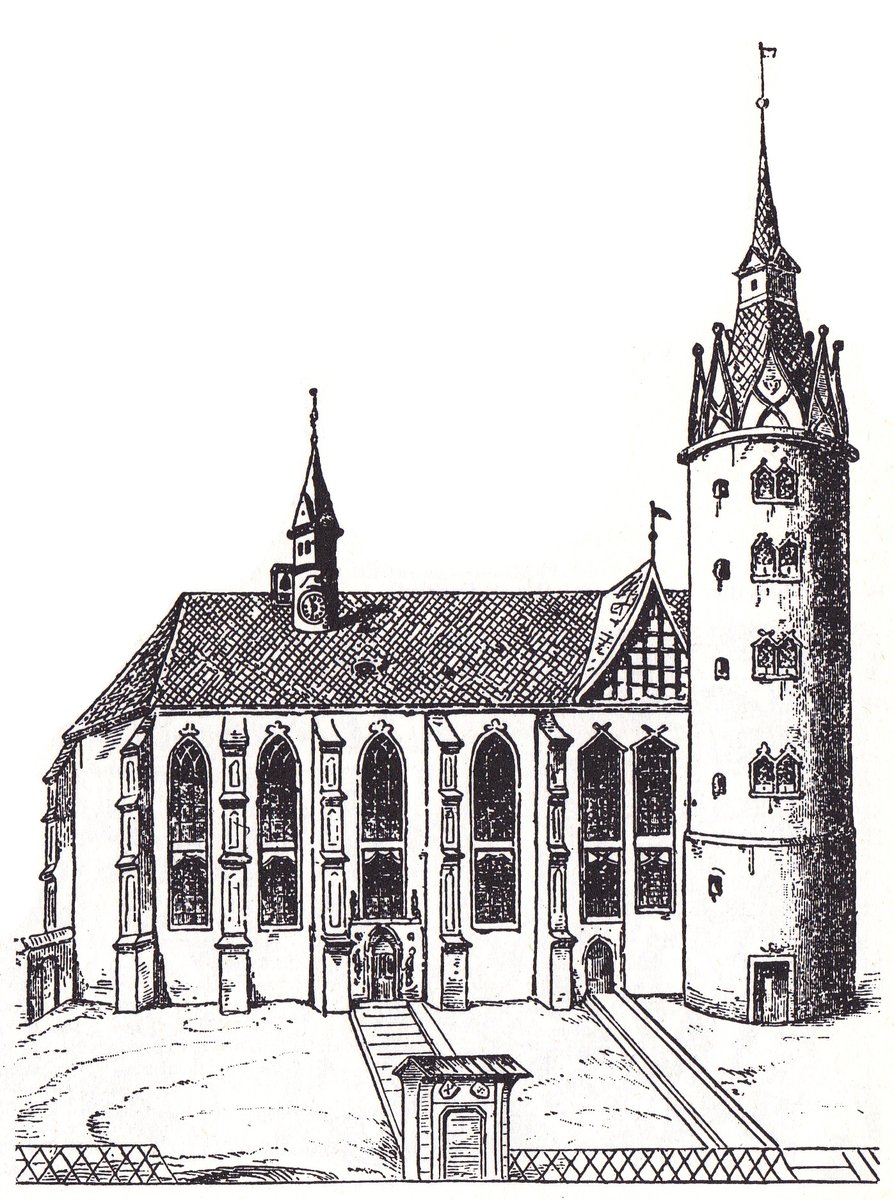
The Castle Church in Wittenberg where Luther posted his 95 Theses, historical engraving public domain -
Finally, Luther didn't nail it there, in fact it wasn't nailed. There was a guy whose job was to post announcements on the doors, and Martin Luther would have given him the notice to put up. He would have stuck it on the door with paste. It was really not very dramatic at all.
-
But what Luther hadn't reckoned with -- what nobody had seen happen ever before -- was becoming a bestselling author. His writings were picked up by these brand new "book publishers", printed and sold without his permission or even his knowledge, and spread like wildfire.
-
It was a self-perpetuating, accelerating cycle: more and more people were buying books, publishers knew Luther would sell, so they printed everything Luther wrote, which meant Luther became more famous, which meant his future books sold even better. It was out of control.
-
As his biographer points out, it was like Martin had written a particularly spicy email to his nerdy friends and it had accidentally gone massively viral. The entire reformation movement is basically "FWD: FWD: FWD: I'm pissed off with the pope".
-
The reformation is also a classic pattern of new information technology: disintermediation. People had previously needed the church to tell them what religion was. Now the printing press meant they could find religious truth directly from the Bible. The church did not like this.
-
The result was the Diet of Worms (a Diet is a kind of meeting, and Worms was the town where it was held). It was presided over by none other than Charles V, Holy Roman Emperor, whose boring ass we just covered recently:
-
At the Diet of Worms the church demanded Luther recant his teachings. He refused and was excommunicated. He wasn't executed because he'd been promised safe passage, so instead he had to immediately go into hiding. His supporters staged a fake kidnapping to spirit him away.
-
While in hiding he continued to write, producing a new translation of the Bible into German. He used a new dialect of German just emerging at the time, and by virtue of writing a gigantic bestseller in that dialect he helped define it, which eventually became modern German.
-
(This trick of defining a language by being the first person to write something really famous in it had been pulled off before by one of our previous subjects, the otherwise tedious Dante Alighieri: TKTKTK)
-
Eventually Martin came out of hiding and, sheltered by pro-Lutheran local politicians, lived to age 63. He churned out book after book, all of them bestsellers, about religion and life and how to live it. He introduced singing into church practice, and composed hymns himself.
-
One of the many church teachings Luther opposed because it wasn't supported by scripture was celibacy for priests; he encouraged priests to get married and have kids, and eventually followed his own teachings by marrying a nun, Katharina von Bora, and having several kids.
-
Luther hesitated for a long time about whether to get married, and I was delighted to learn that one of his friends in persuading him not to delay the decision wrote to him saying "by delay, Hannibal lost Rome", which indeed we saw when we covered him:
-
Side note: all through his life and especially later in life Luther wrote and said anti-Semitic things. These things were later picked up and amplified by the Nazis to justify their own horrifying anti-semitism, using Luther's status as a German national hero to back them up.
-
Luther's anti-semitism is undeniable but also taken somewhat out of context. In Martin Luther's lifetime the Spanish Inquisition was in full swing, burning Jewish people alive just for being Jewish, and anti semitism was widespread and vicious. He was not an outlier.
-
But saying that Luther was not exceptionally anti-semitic for the time of course excuses nothing. The US founding fathers were mostly slave-owners and just because lots of people owned slaves at the time does not make them any less racist shitbags. Just not *exceptionally* so.
-
Luther's legacy is the reformation: a fundamental disintermediation of the church and the fracturing of Christianity into hundreds of sects. This is not at all what he wanted; he wanted to gently correct Catholicism. He hated the term "Lutheran"; he called himself a Christian.
-
But Luther's legacy is really not about him. If the printing press had been invented a hundred years earlier it would probably have been Jan Hus who kicked off the reformation, or a hundred years later somebody else. Luther was a good writer, in the right place at the right time.
-
P.S. Nobody has yet noted that thread 43 comes a week *after* I did thread 44, this is not because I had a grand plan to reference 44 in 43, though I did, but because I messed up the numbering. Conveniently, I had skipped Luther so they are all still chronological.
- Previously: Lucrezia Borgia
- Next: Charles V, Holy Roman Emperor
- Full list
Text and images copyright © 2020-2023 Laurie Voss
except where indicated
except where indicated